 Wonek VPN
NETWORK & WI-FI PLAYBOOK · UPDATED 2026-11-16
Automatic Promotion Back to QUIC When UDP Opens on Co-Working Space Shared Networks
| Network Layer | Without VPN on Co-Working Space Shared Networks | With Wonek VPN Active |
|---|---|---|
| Local Risk Surface | Exposed to multi-tenant office Wi-Fi where client isolation may be misconfigured | Mitigated by how lightweight 64-byte authenticated UDP probes restore peak speed |
| DNS & Destination IPs | Visible to local router / ISP resolver | Encapsulated inside pinned TLS 1.3 tunnel |
| UDP Port Blocking | Standard UDP VPNs hang on 'Connecting' | Automatic WSS:443 & port-80 inner-TLS fallback |
| Public Exit IP Proof | Unverified local/roaming NAT address | Verified exit IPv4 shown on Connection screen |
What happens behind the scenes on Co-Working Space Shared Networks
Connecting an iPhone, iPad, or MacBook to co-working space shared networks introduces specific operational challenges: multi-tenant office Wi-Fi where client isolation may be misconfigured. Even though modern websites use HTTPS for page content, every outbound IP destination, unencrypted DNS query, and connection burst pattern remains visible to the local access point unless encapsulated in a device-wide tunnel.
Focusing on automatic promotion back to quic when udp opens solves this cleanly by how lightweight 64-byte authenticated UDP probes restore peak speed. Because Wonek VPN runs inside Apple's native NetworkExtension PacketTunnel architecture, every app on your device inherits that protection from a single button tap.
Adaptive QUIC + L4S performance and automatic fallback
Where UDP 443 is reachable, Wonek VPN carries packets as independent WebTransport QUIC datagrams with `datagramSendQueueLen=1`, bounded 64-packet per-flow fair scheduling, and L4S ECN negotiation. Unlike legacy TCP-based tunnels, a single dropped wireless frame on a busy access point does not freeze your active voice calls or browser tabs.
When guest firewalls drop UDP packets, Automatic mode races outer TLS WebSocket on port 443 after 700 ms and inner-pinned TLS over port 80 after 1,400 ms — then quietly sends tiny authenticated 64-byte UDP probes every few seconds to promote back to QUIC once UDP becomes available.
Practical limits and cost-smart plan selection
If you only encounter untrusted hotspots a few days or weeks per quarter, you do not need another recurring monthly bill: a one-time VPN on the GO pack ($1.99 for 30 GB / 31 days or $2.99 for 100 GB / 92 days) never auto-renews and syncs automatically across your Apple devices via your App Store account. Remember to accept any captive Wi-Fi splash screen first, keep software updated, and stay alert against phishing links — which encryption alone cannot block.
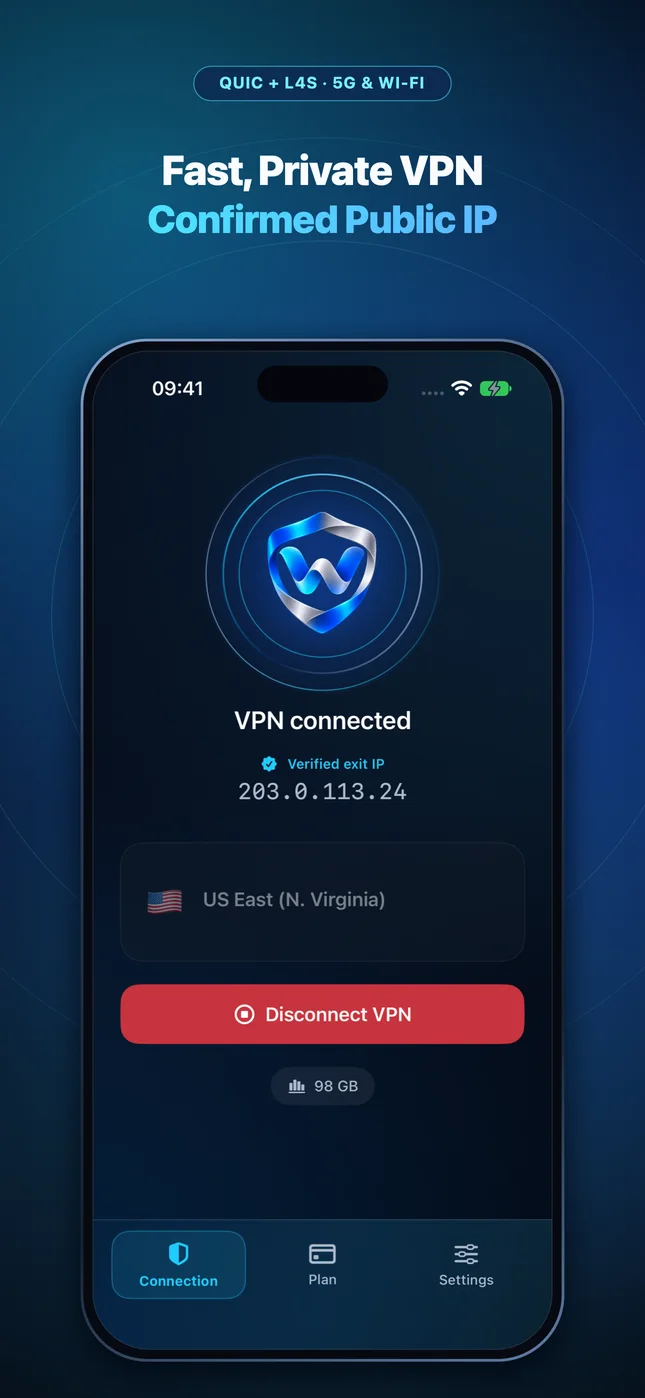
Architecture flow: Automatic transport races low-latency QUIC + L4S datagrams first and seamlessly falls back to pinned inner-TLS over TCP 443/80 on restricted Wi-Fi.
Actionable Verification Checklist
Get Wonek VPN for iPhone, iPad & Mac
Start with a $1.99 one-time 30 GB pack or $2.99 100 GB pack (zero auto-renewal), or choose Standard, On-Demand, or Dedicated Static IPv4.
Frequently Asked Questions
Why do some VPNs fail to connect on co-working space shared networks?
Many venues deploy multi-tenant office Wi-Fi where client isolation may be misconfigured, dropping standard UDP 500/4500/1194 packets. Wonek VPN automatically switches to encrypted TCP 443/80 fallback that resembles ordinary HTTPS web traffic.
Does closing the Wonek VPN app disconnect the tunnel?
No. Apple's system VPN extension keeps running in the background and recovers across network changes until you explicitly tap Disconnect.
Are there any ads or tracking SDKs in Wonek VPN?
None. Neither the iOS/macOS app nor our websites include advertising SDKs or third-party tracking scripts.
How is data usage counted across my iPhone and Mac?
Upload and download bytes are summed transparently across all your devices linked to the same App Store account, with clear per-device breakdowns in the app.
Related Guides in Public Wi-Fi, Roaming & VPN Transport Playbooks
Securing Apple Mail, Calendar & Background Apps on Co-Working Space Shared Networks
Practical guide to securing apple mail, calendar & background apps when connected to co-working space shared networks: why system-level NetworkExtension tunnels
NETWORK & WI-FI PLAYBOOKDiagnosing 'Connecting' Hangs on Restricted Networks on Co-Working Space Shared Networks
Practical guide to diagnosing 'connecting' hangs on restricted networks when connected to co-working space shared networks: distinguishing unpaid captive portal
NETWORK & WI-FI PLAYBOOKKeeping One Consistent Static IPv4 Across Venues on Co-Working Space Shared Networks
Practical guide to keeping one consistent static ipv4 across venues when connected to co-working space shared networks: preventing security lockouts and repeate
NETWORK & WI-FI PLAYBOOKProtecting Remote-Work SaaS Tools Without IT Friction on Co-Working Space Shared Networks
Practical guide to protecting remote-work saas tools without it friction when connected to co-working space shared networks: encrypting business workflows on pe
NETWORK & WI-FI PLAYBOOKKeeping FaceTime, Zoom & Teams Calls Glitch-Free on Airline In-Flight Wi-Fi Portals
Practical guide to keeping facetime, zoom & teams calls glitch-free when connected to airline in-flight wi-fi portals: avoiding TCP head-of-line stalls with ind
NETWORK & WI-FI PLAYBOOKComparing Standard (100 GB) vs On-Demand (200 GB) on Airline In-Flight Wi-Fi Portals
Practical guide to comparing standard (100 gb) vs on-demand (200 gb) when connected to airline in-flight wi-fi portals: matching monthly data volume and warm si
Explore Tools & Companion Silos
Pack vs Subscription Calculator
Interactive 90-day cost calculator comparing $1.99/$2.99 one-time packs vs monthly plans.
RELATED HUBDedicated IPv4 /32 Allowlist Generator
Generate UFW, AWS CLI, Nginx, and PostgreSQL firewall rules in one click.
RELATED HUBQUIC vs TCP Latency Simulator
Simulate head-of-line blocking under packet loss on hotel and cellular Wi-Fi.